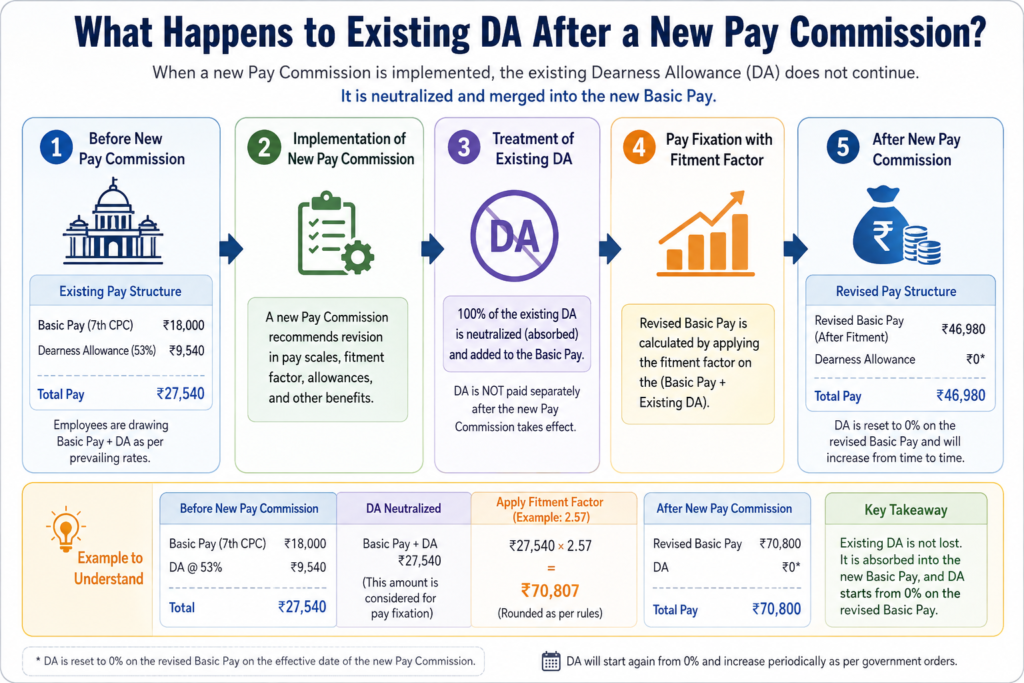

What Happens to Existing DA When a New Pay Commission Is Implemented?
One of the most common questions among Central Government employees whenever a new Pay Commission is discussed is simple: “What will happen to the Dearness Allowance (DA) that I am already receiving?”
If DA has reached a high percentage before a new Pay Commission is implemented, it can look like a large part of the salary is being paid as DA. So it is natural to wonder whether that DA will continue separately, get merged with basic pay, or simply disappear after pay revision.
However, this does not mean that the employee simply “loses” the existing DA. The important point is that the old DA and the new pay structure are connected through the pay-revision formula.
Why Does DA Reset After a New Pay Commission?
DA is designed to compensate employees for the effect of inflation. It is calculated as a percentage of basic pay and is revised periodically.
A Pay Commission, on the other hand, creates or recommends a new pay structure. This can include a revised basic pay, pay matrix, fitment factor and revised rules for allowances.
If the old DA percentage were simply added on top of the newly revised basic pay, employees could receive the same inflation compensation twice. Therefore, when a completely new pay structure is introduced, the accumulated DA is generally absorbed into the pay-revision mechanism.
Does the Existing DA Become Zero?
In practical salary terms, the DA percentage under a newly introduced pay structure can start again from a new base. This is why employees often hear that “DA will become zero under the new Pay Commission.”
But this statement can be misleading if it is interpreted as the accumulated DA being completely lost.
The actual treatment depends on the rules approved by the Government for that particular Pay Commission. The final implementation formula matters more than any assumed DA percentage.
What Happened During the 7th Pay Commission?
The 7th Central Pay Commission provides a useful real-world example.
For migration from the pre-revised pay structure to the 7th CPC Pay Matrix, the approved fixation formula used a 2.57 fitment factor. The 7th CPC report gives illustrative calculations showing existing pay being multiplied by 2.57 and then matched to the appropriate cell in the Pay Matrix.
This is important because the 2.57 factor was not simply a “257% salary increase.” It was part of the mechanism used to move employees from the old pay structure to the new one.
Suppose an employee had an existing basic pay of ₹12,560 under the pre-7th CPC structure.
The amount was rounded and then placed in the appropriate cell of the corresponding Pay Matrix level. The official 7th CPC report illustrates this example and shows fixation at ₹32,300 in the relevant level.
Notice what happened: the old salary structure was replaced by the new Pay Matrix. The employee did not continue with the old basic pay plus the old DA percentage as separate components.
So Where Did the Existing DA Go?
This is the part that often causes confusion.
Think of the pay revision as a restructuring exercise rather than simply adding another percentage to your existing salary.
Before revision, your salary may look broadly like this:
After implementation of a new Pay Commission, the structure may instead look like:
The revised basic pay is determined using the rules of the new pay structure. Therefore, the old DA is accounted for as part of the overall transition rather than continuing indefinitely as an additional component.
A Simple Example Using a Hypothetical New Pay Commission
Let us take a simplified example. This is only an illustration and should not be treated as a prediction of the actual 8th CPC fitment factor or future DA rate.
| Component | Amount |
|---|---|
| Basic Pay | ₹40,000 |
| Existing DA | 60% |
| DA amount | ₹24,000 |
| Basic + DA | ₹64,000 |
Now suppose a future Pay Commission introduces a hypothetical fitment formula of 2.00.
The employee’s revised basic could then be determined according to the applicable Pay Matrix and fixation rules.
The employee would not normally receive:
Instead, the old DA has already been considered within the overall pay-revision mechanism, subject to the actual rules approved for the new Pay Commission.
What Happens to DA After the New Pay Commission?
Once the new pay structure comes into force, DA starts accumulating again according to the new DA calculation rules.
For example, if the revised basic pay is ₹80,000 and the new DA rate later becomes 4%, the DA would be:
If the DA subsequently rises to 8%, it would become:
As the DA percentage increases over the years, the DA amount also increases because it is calculated on the revised basic pay.
Why Does DA Eventually Become a Large Amount Again?
This is the normal cycle of a Pay Commission.
| Stage | What generally happens |
|---|---|
| Old Pay Structure | DA gradually increases with inflation |
| New Pay Commission | Pay is revised and the old structure is replaced |
| Beginning of New Structure | DA rate may restart from a low base |
| Following Years | DA is revised periodically |
| Longer Term | DA becomes a significant part of monthly salary again |
This is why employees should not look only at the DA percentage when comparing the old and new pay structures. The revised basic pay, allowances, pay matrix and DA calculation together determine the actual salary.
Will the New Pay Commission Give DA Arrears?
This is a separate issue.
Whether employees receive arrears depends on the effective date of the revised pay and the date on which the revised salary is actually implemented.
For example, if revised pay is made effective from an earlier date but salary is paid later after the Government issues implementation rules, the difference between the salary actually paid and the salary that should have been paid under the revised structure may become arrears.
Does a Higher Existing DA Mean a Higher New Basic Pay?
Not necessarily in a simple one-to-one manner.
A high DA rate indicates that inflation compensation has accumulated under the existing pay structure. But the revised basic pay will ultimately depend on the fitment formula, pay matrix, minimum pay, existing pay, and other rules approved for the new Pay Commission.
That is why statements such as “DA is already 60%, so the new fitment factor must be 3.00” should be treated cautiously unless supported by an official formula.
What Could This Mean for the 8th Pay Commission?
The same basic principle is important when discussing the 8th Central Pay Commission, but the final treatment cannot be assumed until the Government approves the actual pay-revision rules.
The Department of Expenditure currently maintains a dedicated section for the Eighth Central Pay Commission, alongside the Seventh and Sixth CPC sections.
Therefore, employees should distinguish between:
- the DA rate being paid under the existing 7th CPC structure,
- the fitment factor or equivalent mechanism recommended for the new structure,
- the revised Pay Matrix or pay levels,
- the effective date of the revision, and
- the Government’s final implementation decision.
Does Existing DA Increase Your Pensionable Basic Pay?
For serving employees, the transition to a new Pay Commission can affect the basic pay used for future increments and retirement-related calculations. However, the exact pensionary impact depends on the rules applicable to the employee and the eventual pay fixation provisions.
For pensioners, the treatment is different because Dearness Relief (DR) is used rather than employee DA. Therefore, employees and pensioners should not automatically apply the same calculation to both situations.
Common Misunderstandings About DA and Pay Commission
The old DA does not normally vanish without consideration. The existing pay structure is converted into the revised structure according to the approved fixation formula.
Not necessarily. A new basic pay is established under the revised pay structure, and the old DA is generally accounted for in the transition.
No. The 2.57 factor was a pay-fixation mechanism used for migration to the 7th CPC Pay Matrix. It should not be interpreted as a simple 157% increase in take-home salary.
There is no basis for assuming the exact treatment of DA under a future Pay Commission until the Government’s final rules are issued.
What Employees Should Watch When the New CPC Is Implemented
When the Government eventually announces the implementation details, the following numbers will matter far more than rumours about DA:
- Fitment factor or approved pay-revision formula
- Minimum revised basic pay
- New Pay Matrix
- Effective date
- Method of pay fixation
- DA starting rate under the new structure
- Changes to HRA and other allowances
- Rules for arrears
Frequently Asked Questions
The existing DA is generally accounted for as part of the overall pay-revision and fixation process. The employee then moves to the revised pay structure, under which a new DA rate is applied.
It may start from a new base under the revised structure, but the exact starting rate and treatment will depend on the Government’s final implementation rules.
No. A fitment factor is used to determine revised pay during pay fixation. DA is an inflation-linked allowance calculated as a percentage of basic pay.
No. That would be an oversimplification. A proper calculation requires the official fitment formula and revised Pay Matrix once they are notified.
The 7th CPC moved employees into a new Pay Matrix using the approved pay-fixation mechanism, including a 2.57 fitment factor for normal fixation. The old pay structure was not simply continued with the old DA added separately.