
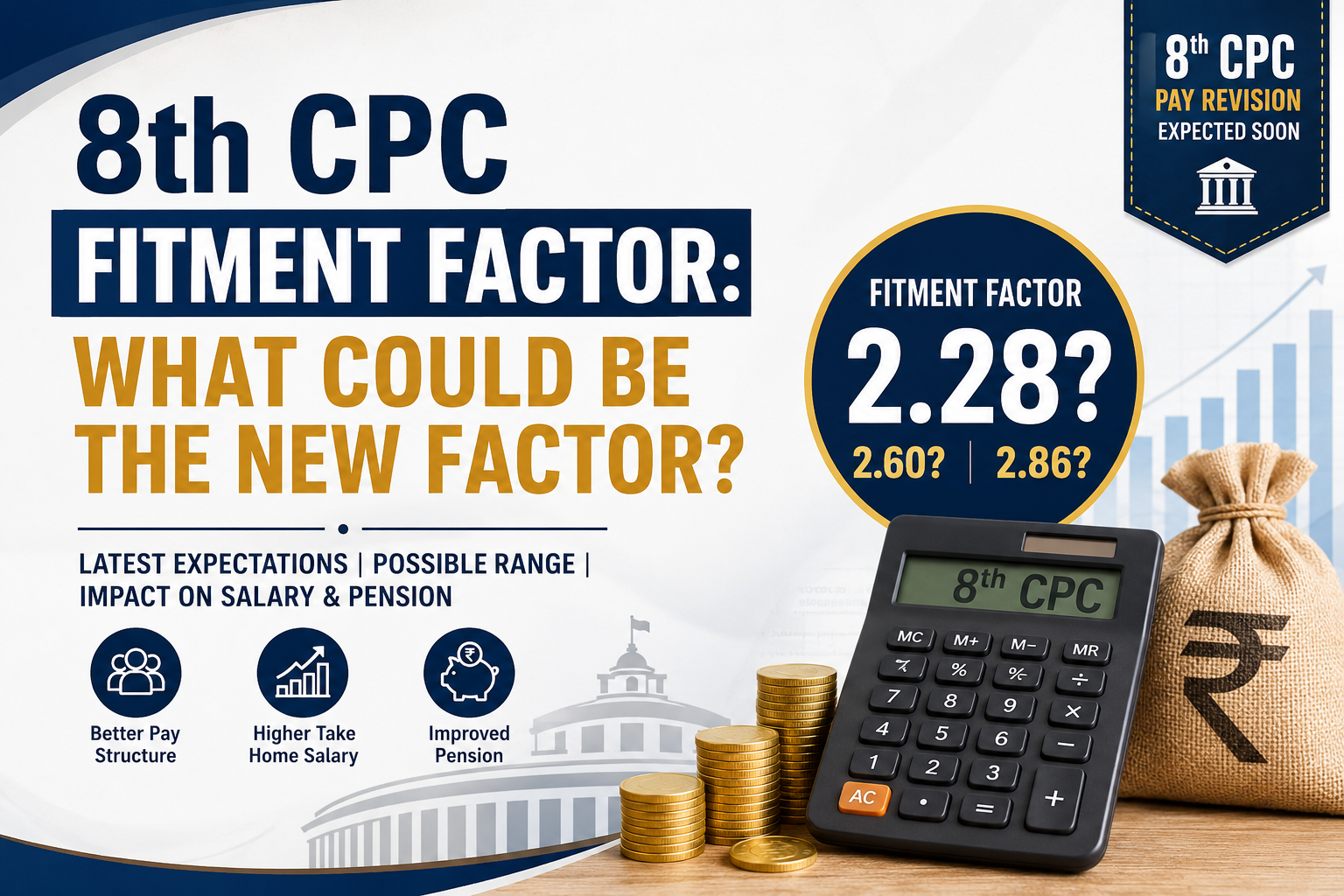
8th CPC Fitment Factor: What Could Be the New Fitment Factor?
The 8th CPC fitment factor is one of the most discussed topics among Central Government employees. Many employees are trying to find out whether the next Pay Commission will use a factor of 2.00, 2.10, 2.50, 2.57 or another figure.
However, there is an important point to understand before looking at any estimate: the final 8th CPC fitment factor has not been officially announced.
The 8th Central Pay Commission is currently carrying out its work, including consultations and collection of data. Therefore, any specific fitment factor mentioned online should currently be treated as a projection rather than a confirmed figure.
What Is the 8th CPC Fitment Factor?
The fitment factor is a multiplier used as part of the pay-revision process to determine revised basic pay under a new pay structure.
In simple terms, a higher fitment factor generally produces a higher revised basic pay when the same current basic pay is used for comparison.
For example, if an employee has a basic pay of ₹30,000 and a hypothetical fitment factor of 2.00 is used:
Illustrative revised basic pay
This is only a mathematical illustration. It should not be interpreted as the final 8th CPC salary calculation.
What Is the Expected 8th CPC Fitment Factor?
At present, there is no officially confirmed number.
Different figures are being discussed by employees, associations and websites, but these should not be confused with an official recommendation of the 8th Central Pay Commission.
The final fitment factor will depend on the Commission’s assessment of pay structure, economic conditions, fiscal considerations and other matters included in its Terms of Reference.
The Government has specifically stated that the Commission will consider factors such as economic conditions, fiscal prudence, resources available for development and welfare, pension-related costs and the likely impact of its recommendations on State Government finances.
Why Are 2.57 and Other Figures Being Discussed?
The number 2.57 is frequently mentioned in discussions about the 8th CPC because it was associated with the implementation of the 7th Central Pay Commission.
However, the 7th CPC fitment factor should not automatically be assumed to be the 8th CPC fitment factor.
The 8th CPC is a separate Pay Commission with its own Terms of Reference and its own examination of pay, allowances, pension and service conditions.
8th CPC Fitment Factor Examples
Until the official factor is announced, it is useful to compare different scenarios.
Suppose an employee’s current basic pay is ₹30,000:
| Hypothetical Factor | Calculation | Illustrative Basic Pay |
|---|---|---|
| 1.80 | ₹30,000 × 1.80 | ₹54,000 |
| 2.00 | ₹30,000 × 2.00 | ₹60,000 |
| 2.10 | ₹30,000 × 2.10 | ₹63,000 |
| 2.50 | ₹30,000 × 2.50 | ₹75,000 |
| 2.57 | ₹30,000 × 2.57 | ₹77,100 |
These figures are included only to demonstrate how a multiplier changes basic pay. They are not predictions of the final 8th CPC pay structure.
Does a 2.00 Fitment Factor Mean a 100% Salary Increase?
No.
This is one of the most important points employees should understand.
If a hypothetical factor of 2.00 is applied to a basic pay of ₹30,000, the mathematical result is ₹60,000. But this does not mean that the employee’s take-home salary will increase by 100%.
The final salary will also depend on the treatment of Dearness Allowance, HRA, Transport Allowance, other allowances and deductions under the new pay structure.
Therefore:
Fitment Factor vs Salary Increase
| Term | Meaning |
|---|---|
| Fitment Factor | A multiplier used as part of the pay-revision process. |
| Revised Basic Pay | The basic pay determined under the new pay structure. |
| Gross Salary | Basic pay plus applicable allowances and other salary components. |
| Take-Home Salary | The amount remaining after applicable deductions and recoveries. |
Why the Final Fitment Factor Matters
The fitment factor is important because it can have a significant effect on the revised basic pay. A difference between two possible factors can become substantial when applied across different pay levels.
For example, consider a current basic pay of ₹50,000:
| Factor | Illustrative Basic Pay |
|---|---|
| 2.00 | ₹1,00,000 |
| 2.10 | ₹1,05,000 |
| 2.50 | ₹1,25,000 |
| 2.57 | ₹1,28,500 |
The examples show why employees are closely watching the eventual fitment factor. However, the final revised pay will have to follow the official pay matrix and implementation rules rather than a simple internet estimate.
Will the 8th CPC Use the Same Fitment Factor for Everyone?
A single fitment methodology may be used across the pay structure, but the actual revised pay of an employee will depend on the applicable pay level and the final pay matrix.
Therefore, employees should not calculate their future salary simply by multiplying their current monthly salary by a proposed factor.
The correct calculation will become possible once the Government publishes the final pay-revision rules and revised pay matrix.
When Will the 8th CPC Fitment Factor Be Announced?
The 8th Central Pay Commission is still carrying out its work. The Commission has been collecting data and conducting consultations with stakeholders.
For example, the official Commission website has published notices relating to stakeholder interactions and data submission. The Commission’s online data portal also requested data from Ministries, Departments, organisations and offices.
As of August 2026, there is therefore no official notification fixing the final fitment factor.
Employees should be cautious about social media posts or headlines claiming that a particular factor has already been approved unless the information is supported by an official Government or 8th CPC source.
What Should Central Government Employees Watch For?
Instead of focusing only on the fitment factor, employees should watch for several important developments:
- 8th CPC recommendations
- Final fitment methodology
- Revised pay matrix
- Treatment of existing Dearness Allowance
- Changes in HRA and other allowances
- Implementation orders issued by the Government
- Any official clarification regarding the effective date
These factors together will determine the actual impact on salary.
What Is the Expected 8th CPC Salary Increase?
It is too early to give a reliable percentage increase.
A higher fitment factor would generally result in a higher revised basic pay under a simple multiplier scenario, but the final salary increase cannot be determined from the fitment factor alone.
For a broader explanation of how the possible salary revision could affect Central Government employees, see our main guide:
8th CPC Salary: How Much Will Your Salary Increase?
How to Calculate Your Possible 8th CPC Basic Pay
For a simple scenario calculation, you can use:
For example, with a current basic pay of ₹40,000 and a hypothetical factor of 2.10:
This is only a scenario calculation. The actual revised basic pay may be determined differently depending on the final 8th CPC recommendations and the Government’s implementation rules.
Frequently Asked Questions
What is the 8th CPC fitment factor?
The 8th CPC fitment factor will be a key part of the future pay-revision process, but the final factor has not yet been officially announced.
Is 2.57 the 8th CPC fitment factor?
No. There is no official confirmation that 2.57 will be used for the 8th CPC. The figure is associated with the 7th CPC and should not be treated as the confirmed 8th CPC factor.
Is 2.86 the confirmed 8th CPC fitment factor?
No. Any specific figure circulating online should be treated as an estimate unless it is officially announced by the Government or the 8th Central Pay Commission.
Will a 2.00 fitment factor double my salary?
No. A 2.00 multiplier in a simple basic-pay illustration would double the basic-pay figure used in that calculation, but it would not automatically double gross or take-home salary.
When will the 8th CPC fitment factor be finalised?
The final factor will become known only after the Commission submits its recommendations and the Government announces the decision and implementation details.
Where can I check the official 8th CPC fitment factor?
Check the official 8th Central Pay Commission website and official Government of India announcements.
Final Takeaway
The 8th CPC fitment factor is not officially known yet. Figures such as 2.00, 2.10, 2.50, 2.57 and 2.86 can be used to understand different salary scenarios, but none should be presented as the confirmed 8th CPC factor without an official announcement.
The most important thing for employees is to wait for the complete pay-revision framework, including the revised pay matrix and allowance rules.
Until then, scenario calculations can help employees understand the possible impact without creating unrealistic expectations.
For a broader explanation of the possible salary revision, read our 8th CPC Salary guide.