
Basic Pay vs Gross Pay vs Net Pay: What’s the Difference?
When you look at your salary slip, you may come across terms like Basic Pay, Gross Pay and Net Pay. All three are important, but they don’t mean the same thing.
If you’ve ever wondered why your Basic Pay is much lower than your total salary, or why your Gross Pay is higher than the amount credited to your bank account, this guide will make it simple.
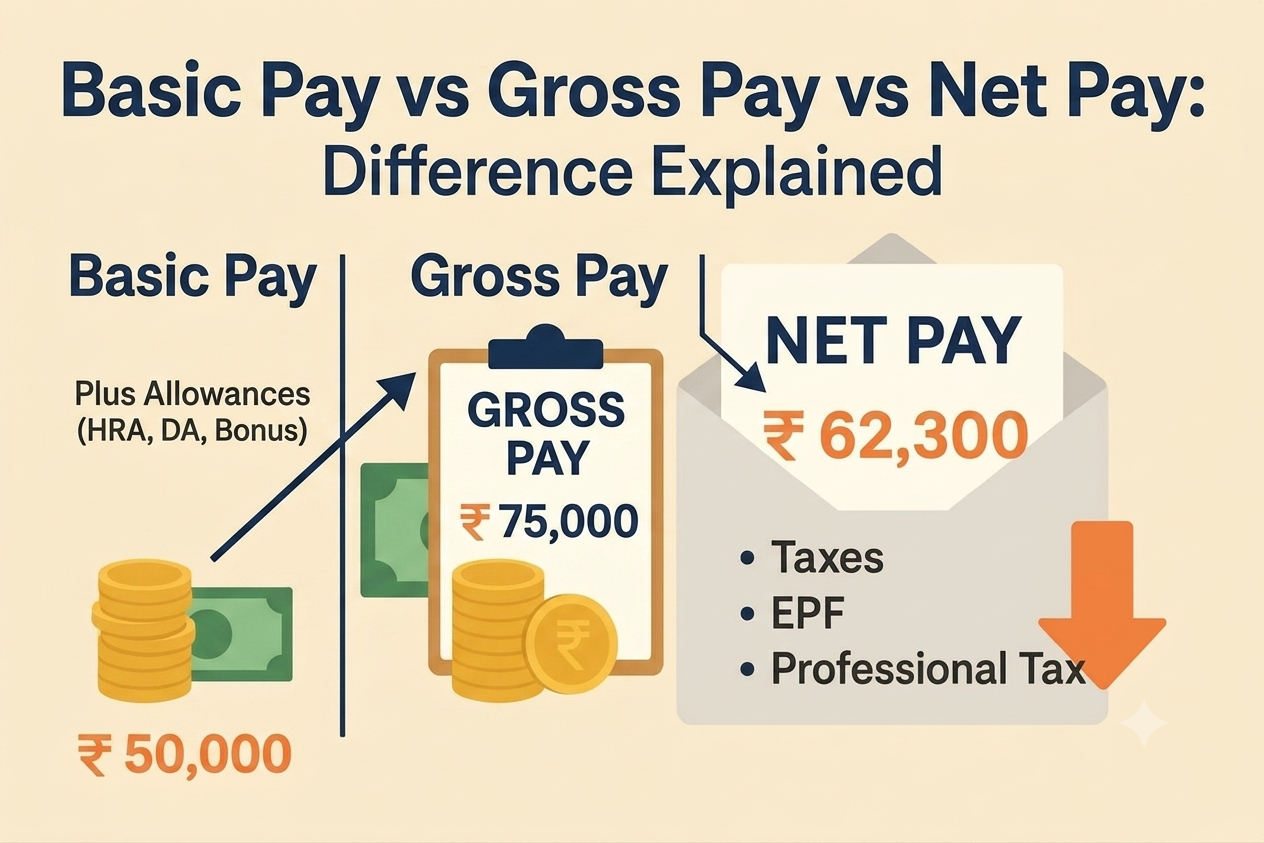
Basic Pay is the core salary → Gross Pay is your total earnings before deductions → Net Pay is what you actually receive after deductions.
Summary
Basic Pay is the main component of your salary. For Central Government employees, it is linked to the employee’s position in the applicable Pay Matrix.
Gross Pay is the total amount you earn before deductions. It can include Basic Pay along with applicable allowances such as DA, HRA and Transport Allowance.
Net Pay is the amount that remains after deductions. This is generally the amount that gets credited to your bank account.
So, the three terms basically describe three different points in your salary calculation.
Basic Pay vs Gross Pay vs Net Pay — At a Glance
| Particular | Basic Pay | Gross Pay | Net Pay |
|---|---|---|---|
| What is it? | Core salary component | Total earnings before deductions | Amount received after deductions |
| Includes allowances? | No | Yes, where applicable | Already reflected in the final amount |
| Includes deductions? | No | No | Yes |
| Why is it important? | Forms the base for several pay-related calculations | Shows total salary earned | Shows your actual take-home amount |
| Simple example | ₹40,000 | ₹70,600 | ₹61,000 |
What Exactly Is Basic Pay?
Think of Basic Pay as the foundation of your salary.
For a Central Government employee, Basic Pay is determined according to the applicable pay structure and Pay Matrix. It doesn’t represent the entire salary you receive every month.
Other components can be added to it depending on your eligibility and place of posting. For example, DA, HRA and Transport Allowance may form part of your monthly earnings.
Suppose your Basic Pay is ₹40,000. That doesn’t mean your monthly salary will be ₹40,000. Your actual salary can be considerably higher after adding applicable allowances.
Basic Pay = The starting point of your salary calculation.
What Is Gross Pay?
Gross Pay is the total salary you earn before deductions.
It is generally made up of Basic Pay plus the allowances and other eligible earnings applicable to you.
For example:
Basic Pay: ₹40,000
DA: ₹22,000
HRA: ₹5,000
Transport Allowance: ₹3,600
Gross Pay: ₹70,600
This means the employee has earned ₹70,600 before deductions are taken into account.
Of course, the actual amount and components will vary from one employee to another.
What Is Net Pay?
This is probably the number most employees are interested in: how much money will actually reach my bank account?
That’s where Net Pay comes in.
Net Pay is the amount left after applicable deductions are taken from your Gross Pay.
For example, if your Gross Pay is ₹70,600 and your total deductions are ₹9,600:
Your illustrative Net Pay would therefore be ₹61,000.
Deductions can include items such as NPS contribution, income-tax/TDS, CGHS or other recoveries, insurance, loans, advances and other applicable deductions.
Let’s Understand It With One Simple Example
Suppose an employee has the following salary components:
| Basic Pay | ₹40,000 |
| DA | ₹22,000 |
| HRA | ₹5,000 |
| Transport Allowance | ₹3,600 |
| Gross Pay | ₹70,600 |
| Total deductions | ₹9,600 |
| Net Pay | ₹61,000 |
So, in this example:
- Basic Pay = ₹40,000
- Gross Pay = ₹70,600
- Net Pay = ₹61,000
That’s the easiest way to see how the three figures are connected.
Why Is Basic Pay So Important?
Basic Pay isn’t simply another number on your salary slip. It can be the starting point for several salary-related calculations.
For example, DA is generally calculated as a percentage of Basic Pay. Depending on the applicable rules, other benefits and calculations may also be linked to Basic Pay or specified salary components.
That’s why an increase in Basic Pay can have an effect on other parts of your salary as well.
Why Is Gross Pay Higher Than Net Pay?
This is straightforward: deductions are made from your Gross Pay.
Your Gross Pay represents what you have earned before those deductions. Your Net Pay is what remains afterwards.
For example:
Gross Pay: ₹70,600
Less: Deductions: ₹9,600
Net Pay: ₹61,000
So don’t be surprised if the Gross Pay shown on your salary slip is considerably higher than the amount credited to your bank account.
Gross Pay vs Gross Total Income — Don’t Mix Them Up
These two terms sound similar, but they are used for different purposes.
Gross Pay generally refers to your earnings from salary before payroll deductions.
Gross Total Income is a tax-related term used while determining taxable income. It can include income from different sources and is used in the income-tax computation process.
If you’re checking your tax position, Form 16 and your income-tax records are more useful than simply looking at the Gross Pay figure on your monthly salary slip.
Which Figure Should You Check?
It depends on what you want to know.
- Want to know your pay level? → Check Basic Pay.
- Want to know your total earnings? → Check Gross Pay.
- Want to know how much reaches your bank? → Check Net Pay.
- Want to check your tax-related salary details? → Check Form 16 and your tax computation.
Useful CGStaffTools Calculators
If you’re checking your Central Government salary, these tools may also be useful:
Calculate your 7th CPC salary components. 7th CPC DA Calculator
Calculate DA based on Basic Pay. 7th CPC HRA Calculator
Check applicable HRA calculations.
Official References
For tax-related salary information, it is always better to refer to official sources rather than relying only on general salary calculators.
- Income Tax Department — Individual Taxpayer Information
- Income Tax Department — Income Tax Forms
- Income Tax Department — Income Tax Return Downloads
The Easy Way to Remember
Basic Pay = Your core salary
Gross Pay = Your total earnings before deductions
Net Pay = What you actually receive
So the next time you look at your salary slip, you don’t need to get confused by the different figures. Start with Basic Pay, add the applicable earnings to arrive at Gross Pay, and then account for deductions to arrive at Net Pay.
That’s the whole idea in a nutshell.
Note: Actual salary components, allowances, deductions and tax treatment depend on the employee’s circumstances and the applicable rules. The figures used in this article are illustrative examples for easy understanding.