
8th CPC Effective Date: When Will the New Salary Be Implemented?
The 8th CPC effective date is one of the biggest questions among Central Government employees. Many employees want to know whether the revised salary will be applicable from 1 January 2026 and when they can actually expect the new basic pay, allowances and arrears.
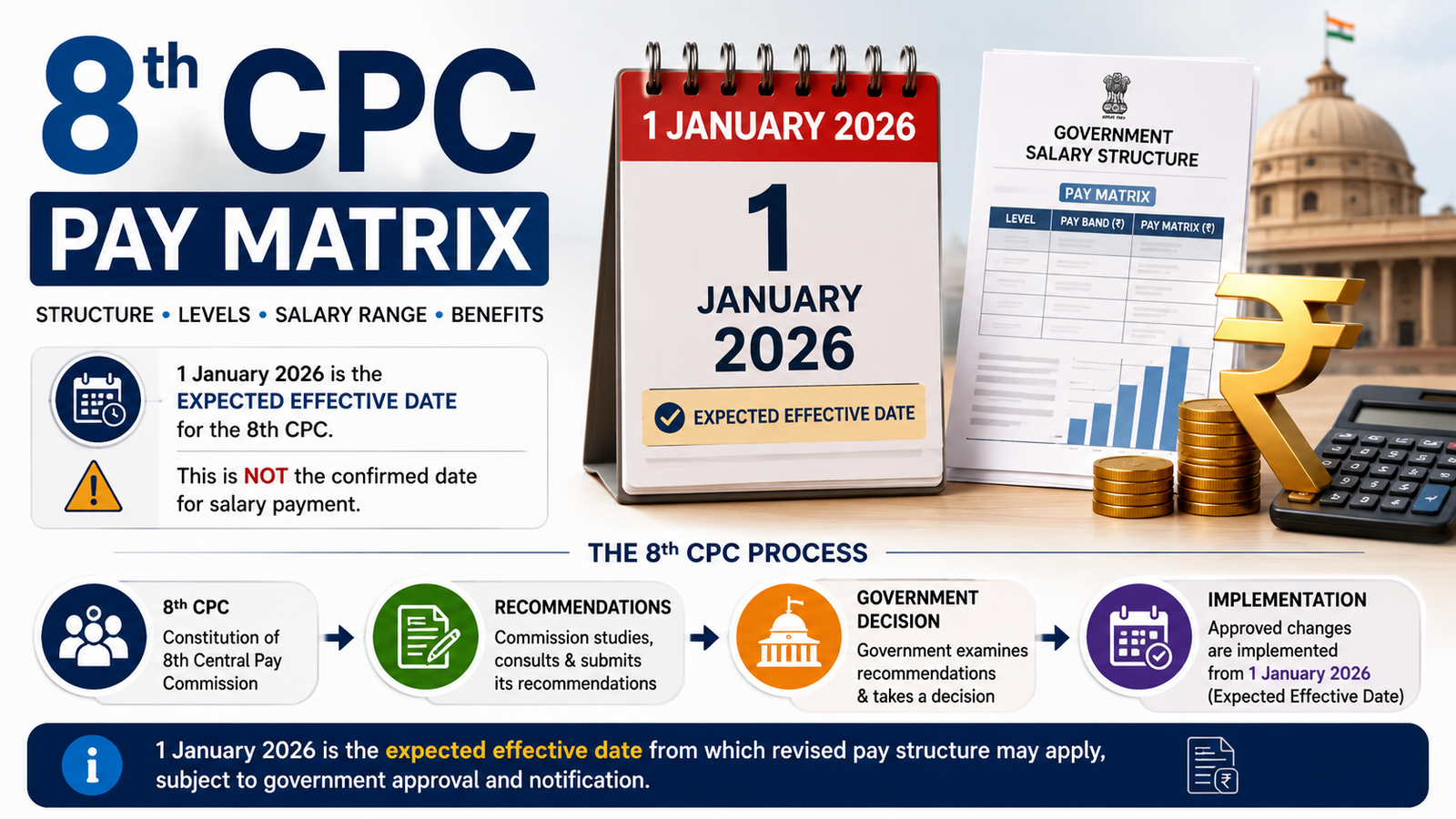
There is an important distinction to understand. The Government has stated that, following the usual 10-year cycle, the effect of the 8th Central Pay Commission recommendations would normally be expected from 1 January 2026. However, this does not mean that the revised 8th CPC salary has already been implemented from that date.
What Is the 8th CPC Effective Date?
The term 8th CPC effective date generally refers to the date from which the financial effect of the recommendations of the 8th Central Pay Commission is expected to apply.
In its announcement on the Terms of Reference of the 8th CPC, the Government stated that Central Pay Commission recommendations are usually implemented at intervals of around ten years. Following this trend, the effect of the 8th CPC recommendations would normally be expected from 01.01.2026.
This statement is important, but it should not be interpreted as an announcement that the new salary structure has already been implemented.
Is 8th CPC Effective From 1 January 2026?
1 January 2026 is the expected effective date of the recommendations, but the revised 8th CPC pay structure has not yet been implemented.
The 8th Central Pay Commission was formally constituted on 3 November 2025 and has been given 18 months to submit its report.
As of August 2026, the Commission is still carrying out consultations, meetings and other activities as part of its work.
Therefore, employees should distinguish between the expected effective date and the actual date on which revised salary is implemented and paid.
Why Is There a Difference Between Effective Date and Implementation Date?
A Pay Commission does not directly change an employee’s salary merely by being constituted.
The normal process involves several stages:
↓
Consultations & Data Collection
↓
Recommendations by the Commission
↓
Government Examination & Decision
↓
Implementation Orders
↓
Revised Salary & Arrears, if applicable
This is why the phrase “effective from 1 January 2026” should not be confused with the date on which employees will actually start receiving revised salary.
When Will the 8th CPC Submit Its Report?
The Government constituted the 8th Central Pay Commission on 3 November 2025.
The Commission has been given 18 months to submit its recommendations.
Based on this timeline, the Commission’s report would fall within the 18-month period from the date of constitution. However, the exact timing of the final report and the subsequent Government decision should not be assumed until officially announced.
The Commission is currently conducting consultations and other activities. Its official website continues to publish notices relating to meetings, stakeholder interactions and State/UT visits.
Will the 8th CPC Salary Be Paid From January 2026?
It is important to separate the effective date from the payment date.
If the Government ultimately approves revised pay with effect from 1 January 2026, employees could potentially become entitled to the financial benefits from that date, subject to the final implementation orders.
Any difference between the approved effective date and the date on which revised salary is actually paid could result in arrears, depending on the final Government orders.
Will There Be 8th CPC Arrears From 1 January 2026?
Arrears are possible if the final Government decision gives the revised pay structure retrospective effect from 1 January 2026 and the revised salary is implemented at a later date.
For example, if revised pay is ultimately approved with effect from 1 January 2026 but employees begin receiving the revised salary later, the difference for the eligible period could potentially be paid as arrears.
However, the exact treatment of arrears, including eligibility, calculation and payment schedule, will depend on the final Government orders.
Therefore, it is too early to calculate a confirmed 8th CPC arrears amount.
Does 1 January 2026 Mean the 8th CPC Salary Is Already Final?
No.
The effective date does not determine the final salary by itself.
The final salary will depend on the recommendations of the 8th CPC and the Government’s decision regarding the revised pay structure.
Several important elements are still not officially finalised, including:
- 8th CPC fitment factor
- Revised Pay Matrix
- Revised basic pay
- Allowance structure
- Dearness Allowance treatment
- Rules for pay fixation
- Implementation procedure
- Arrears calculation and payment, if applicable
What Is the Current Status of the 8th CPC?
The 8th Central Pay Commission is currently working on its mandate.
The official Commission website shows ongoing activities including consultations and State/UT visits. Recent notices have included visits to locations such as Chennai and Puducherry.
The Commission has also invited inputs and collected information from various stakeholders as part of the process.
This means the Commission’s work is still in progress and the final pay revision cannot yet be treated as settled.
Visit the official 8th Central Pay Commission website
Will the 8th CPC Be Implemented Immediately After the Report?
Not necessarily.
After the Commission submits its recommendations, the Government will need to examine them and decide which recommendations to accept and how they will be implemented.
The Government may issue separate orders covering pay, allowances, pension and other related matters.
Therefore, the date of submission of the 8th CPC report and the date on which revised salary is actually implemented may not be the same.
How Will the Effective Date Affect Your Salary?
If the final recommendations are approved with effect from 1 January 2026, the effective date could become important when calculating the difference between the old and revised salary.
For example, suppose an employee’s existing basic pay is ₹40,000 and the final revised basic pay is later determined to be ₹80,000 under the approved pay structure.
The difference between the applicable old and revised salary components for the eligible period could form part of the arrears calculation, subject to the final rules.
This is only an illustration. The actual calculation would need to consider the final basic pay, DA, allowances, deductions and the specific Government orders.
8th CPC Effective Date vs Implementation Date
| Term | Meaning |
|---|---|
| Expected Effective Date | 1 January 2026, based on the Government’s statement about the usual 10-year cycle. |
| Commission Report | The recommendations submitted by the 8th Central Pay Commission. |
| Government Decision | The Government’s decision on the recommendations. |
| Implementation Date | The date from which the revised salary structure is actually implemented through Government orders. |
| Arrears | Potential difference payable for an earlier eligible period if revised pay is given retrospective effect. |
What Should Central Government Employees Expect Next?
The next major milestones to watch are:
- Completion of the 8th CPC consultations and examination
- Submission of the Commission’s recommendations
- Government consideration of the recommendations
- Decision on the revised pay structure
- Publication of implementation orders
- Finalisation of revised Pay Matrix and allowances
- Calculation and payment of arrears, if applicable
Until these stages are completed, salary figures circulating online should be treated as estimates rather than final Government figures.
How Does the Effective Date Connect With the 8th CPC Salary?
The effective date is only one part of the overall salary-revision process.
The final salary will depend on the revised Pay Matrix, fitment methodology and allowance rules.
For a detailed explanation of how the possible salary revision could affect Central Government employees, read our 8th CPC Salary: How Much Will Your Salary Increase? guide.
You can also read our 8th CPC Fitment Factor guide and 8th CPC Pay Matrix guide to understand the other major components of the expected pay revision.
Frequently Asked Questions
What is the 8th CPC effective date?
The Government has stated that, following the usual 10-year cycle for Pay Commission recommendations, the effect of the 8th CPC recommendations would normally be expected from 1 January 2026.
Is the 8th CPC salary implemented from 1 January 2026?
No. The 8th CPC recommendations and revised salary structure have not yet been implemented. The Commission is still working on its recommendations.
Will 8th CPC arrears be paid from January 2026?
Arrears could arise if the Government ultimately approves revised pay with retrospective effect from 1 January 2026 and implements it later. The actual arrears rules and payment schedule will depend on the final Government orders.
When will the 8th CPC report be submitted?
The Commission has been given 18 months from its constitution on 3 November 2025 to submit its recommendations.
When will the 8th CPC salary be implemented?
The actual implementation date is not yet officially announced. It will depend on the Commission’s recommendations and the Government’s subsequent decision and implementation orders.
Is 1 January 2026 the confirmed date for receiving the revised salary?
No. 1 January 2026 is the date from which the effect of the recommendations would normally be expected according to the Government’s October 2025 statement. It is not a confirmed date for receiving revised salary.
Where can I check the latest 8th CPC updates?
The official 8th Central Pay Commission website is the best source for official notices, consultations and Commission-related updates.
Final Takeaway
The 8th CPC effective date is expected to be 1 January 2026, based on the Government’s statement that the effect of the recommendations would normally follow the usual 10-year cycle.
However, this does not mean that the revised 8th CPC salary has already been implemented from that date.
The Commission is still working on its recommendations. After its report is submitted, the Government will have to consider the recommendations and issue the necessary implementation decisions.
If the final pay revision is approved with effect from 1 January 2026 but implemented later, eligible employees may receive arrears according to the final Government orders.
For now, employees should treat 1 January 2026 as the expected effective date of the recommendations, not as the date on which the revised salary is already payable.