
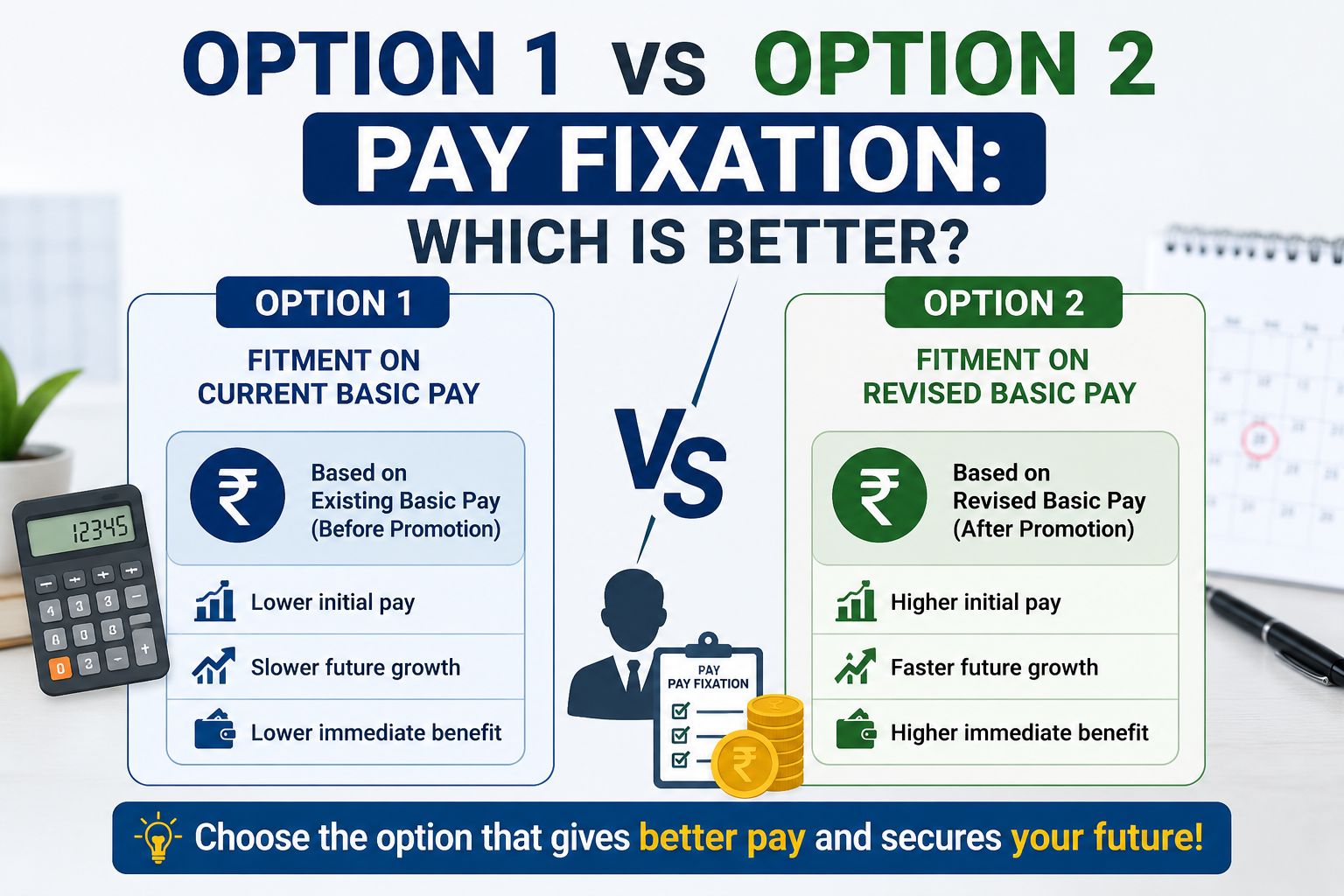
Option 1 vs Option 2 Pay Fixation Under 7th CPC: Which is Better?
Understand the difference between Option 1 and Option 2 for pay fixation on promotion, how the date of next increment affects your pay, and how to choose the more beneficial option.
Pay fixation on promotion is one of the most important salary-related decisions for Central Government employees. Under the 7th Central Pay Commission (7th CPC), an employee promoted to a higher Pay Level can generally have a choice regarding the effective date of fixation.
This is where Option 1 and Option 2 pay fixation become important.
Choosing between the two options can affect the employee’s basic pay, date of next increment and subsequent salary progression. Therefore, it is not always correct to assume that one option is automatically better than the other.
There is no single option that is best for every employee. The better option depends on the promotion date, existing basic pay, promotional Pay Level and the resulting date of next increment. The two options should be compared before exercising the choice.
Want to compare your own pay fixation?
Use the CGStaffTools Pay Fixation Calculator to calculate your revised basic pay and compare the fixation outcome based on your promotion and increment dates.
Open Pay Fixation Calculator →What is Pay Fixation on Promotion?
When a Central Government employee is promoted from a lower Pay Level to a higher Pay Level, the basic pay has to be fixed in the higher level. This process is known as pay fixation on promotion.
Under the 7th CPC Pay Matrix system, pay fixation is generally carried out by providing the prescribed increment in the lower level and then placing the employee at the corresponding stage in the higher Pay Level.
The important point is that an employee may have a choice regarding the date from which the fixation is made. Depending on the circumstances, the employee may opt for fixation from the date of promotion or from the date of the next increment.
What are Option 1 and Option 2?
In simple terms, the two choices can be understood by looking at when the employee wants the pay fixation to take effect.
| Feature | Option 1 | Option 2 |
|---|---|---|
| Fixation approach | Fixation from the date of promotion | Fixation from the date of next increment |
| Immediate benefit | Higher-level pay is fixed immediately | Existing pay continues until the chosen fixation date, subject to applicable rules |
| Important consideration | Immediate revised basic pay | Potential benefit from re-fixation on the increment date |
| Best suited for | Employees who benefit from immediate fixation | Employees for whom deferred fixation produces a better progression |
How Does Option 1 Work?
Under the first approach, pay is fixed in the higher Pay Level from the date of promotion.
The broad calculation involves granting the prescribed increment in the lower Pay Level and then identifying the corresponding equal or next higher cell in the promotional Pay Level.
↓
One increment in the lower Pay Level
↓
Equal or next higher cell in the promotional Pay Level This gives the basic pay after fixation, subject to the applicable rules.
The main advantage is that the employee receives the benefit of the higher-level fixation from the date of promotion rather than waiting for the next increment date.
How Does Option 2 Work?
Under the second approach, the employee may choose fixation from the date of the next increment, where such an option is available under the applicable rules.
This can be useful because the employee’s pay is allowed to progress in the existing level until the selected date, after which fixation is carried out in the higher Pay Level.
The attraction of this option is that the resulting pay progression can sometimes be better than immediate fixation, particularly when the promotion takes place relatively close to the existing increment cycle.
The better question is: “Which option produces the better pay progression after considering the next increment date?”
Why is the Date of Next Increment Important?
The Date of Next Increment (DNI) is one of the most important factors when comparing pay-fixation options.
If the employee chooses fixation from the date of the next increment, the calculation has to take into account what the employee’s pay would become on that date and how that pay is subsequently placed in the higher Pay Level.
This is why two employees promoted to the same Pay Level can sometimes arrive at different outcomes even if their current basic pay is similar.
Worked Example: Comparing the Two Options
Consider a simplified example to understand the concept.
| Existing Pay Level | Level 4 |
| Existing Basic Pay | ₹30,800 |
| Promotional Pay Level | Level 5 |
| Date of Promotion | 15 July |
| Next Increment Date | 1 January |
For illustration, assume that the employee’s pay in the lower level is first increased by the applicable increment and the resulting amount is then placed in the promotional level at the equal or next higher cell.
With Option 1, the fixation is effective from the promotion date. The employee therefore receives the benefit of the higher-level fixation immediately, subject to the applicable rules.
With Option 2, the employee continues under the applicable existing pay arrangement until the selected increment date, after which the pay is re-fixed in the higher level.
- Basic pay immediately after promotion
- Basic pay on the next increment date
- Basic pay after fixation in the higher Pay Level
- Next increment date after fixation
- Longer-term basic pay progression
This is precisely why manually comparing only the first month’s salary can sometimes produce the wrong conclusion.
Option 1 vs Option 2: Side-by-Side Comparison
| Point of comparison | Option 1 | Option 2 |
|---|---|---|
| Effective fixation | From promotion | From next increment, where applicable |
| Higher-level pay | Available earlier | Available from the selected fixation date |
| Calculation complexity | Usually simpler | Requires comparison with DNI |
| Immediate salary impact | Can be higher | May initially be lower |
| Long-term result | Depends on fixation and increment dates | Can sometimes produce a better progression |
| Best choice | Depends on individual case | Depends on individual case |
Which is Better: Option 1 or Option 2?
There is no universal answer.
Option 1 may be attractive when the employee wants the higher-level pay fixation to take effect immediately from the promotion date.
Option 2 may be more beneficial in cases where waiting until the next increment date results in a more favourable fixation and subsequent pay progression.
The difference may look small initially, but even a small difference in basic pay can affect future increments and other salary-linked benefits over time.
Compare the pay immediately after promotion, the pay on the next increment date and the subsequent increment cycle before making the final choice.
Factors to Consider Before Choosing an Option
1. Date of Promotion
The interval between the promotion date and the next increment date can have a significant effect on the comparison.
2. Existing Basic Pay
Your current basic pay determines the cell reached after applying the prescribed increment and moving to the promotional Pay Level.
3. Promotional Pay Level
The difference between the existing and promotional Pay Levels directly affects the fixation calculation.
4. Date of Next Increment
DNI is particularly important when comparing a deferred fixation with immediate fixation.
5. Future Pay Progression
Do not stop at the first month. Compare how the two options affect future increments as well.
Common Mistakes Employees Make
- Assuming Option 1 is always better because the higher pay starts immediately.
- Choosing Option 2 without calculating the eventual re-fixation.
- Looking only at the first month’s salary.
- Ignoring the Date of Next Increment.
- Comparing basic pay without considering the applicable Pay Matrix cells.
- Using an outdated pay-fixation method.
- Exercising an option without checking the applicable departmental instructions.
How to Compare Option 1 and Option 2 Easily
Manual pay fixation can become confusing because several dates and Pay Matrix cells have to be considered simultaneously.
A calculator can make the comparison much easier.
Calculate Your Pay Fixation
Enter your existing Pay Level, Basic Pay, promotion date and Date of Next Increment to understand the applicable fixation outcome.
Use the Pay Fixation Calculator →Frequently Asked Questions
Is Option 1 always better than Option 2?
No. Option 1 provides fixation from the promotion date, but Option 2 can be more beneficial in some circumstances because of the subsequent fixation and increment cycle.
What is the main difference between Option 1 and Option 2?
The key difference is the date from which pay fixation takes effect. Option 1 generally considers fixation from the promotion date, while Option 2 involves fixation from the next increment date where the applicable rules permit such an option.
Why is the Date of Next Increment important?
The Date of Next Increment determines when the employee’s pay progresses and can significantly influence the result when comparing immediate and deferred fixation.
Can Option 2 result in higher future basic pay?
It can, depending on the employee’s pay, promotion date, promotional level and applicable fixation rules. The actual result should be calculated for the individual case.
Should I compare only the basic pay after promotion?
No. A proper comparison should also consider the next increment date and subsequent pay progression.
Can I calculate both options online?
Yes. The CGStaffTools Pay Fixation Calculator is designed to help Central Government employees work through their pay-fixation calculation and compare the resulting figures.
Final Takeaway
Option 1 vs Option 2 pay fixation is not a one-size-fits-all decision. The correct choice depends on the employee’s individual pay, promotion date, Pay Level and Date of Next Increment.
Option 1 has the advantage of providing higher-level fixation from the promotion date, while Option 2 can provide a different pay progression when fixation is deferred to the next increment date under the applicable rules.
Therefore, before exercising an option, calculate both outcomes and compare not only the immediate basic pay but also the subsequent increment and long-term pay progression.
Disclaimer: This article is intended for general informational purposes. Pay fixation provisions can depend on the applicable Central Government rules, orders and the employee’s individual circumstances. Employees should verify the applicable provisions with their Establishment/Pay Section or the competent authority before exercising any option.
Official References for Pay Fixation
“`The following official Government of India resources can be used to verify the applicable 7th CPC pay-fixation provisions, Pay Matrix and related rules.
- Department of Expenditure, Ministry of Finance — Official source for Central Government pay-related orders and notifications.
- 7th Central Pay Commission – Department of Expenditure — Reference material relating to the 7th CPC recommendations and implementation.
- Department of Expenditure – Orders & Circulars — Useful for checking official Government orders and subsequent clarifications.
- Central Civil Services (Revised Pay) Rules, 2016 — Reference for the revised pay structure and related provisions under the 7th CPC.
- Ministry of Finance — Official Ministry of Finance portal for Central Government financial and pay-related information.