
Retirement Age for Central Government Employees: Rules & Retirement Date Explained
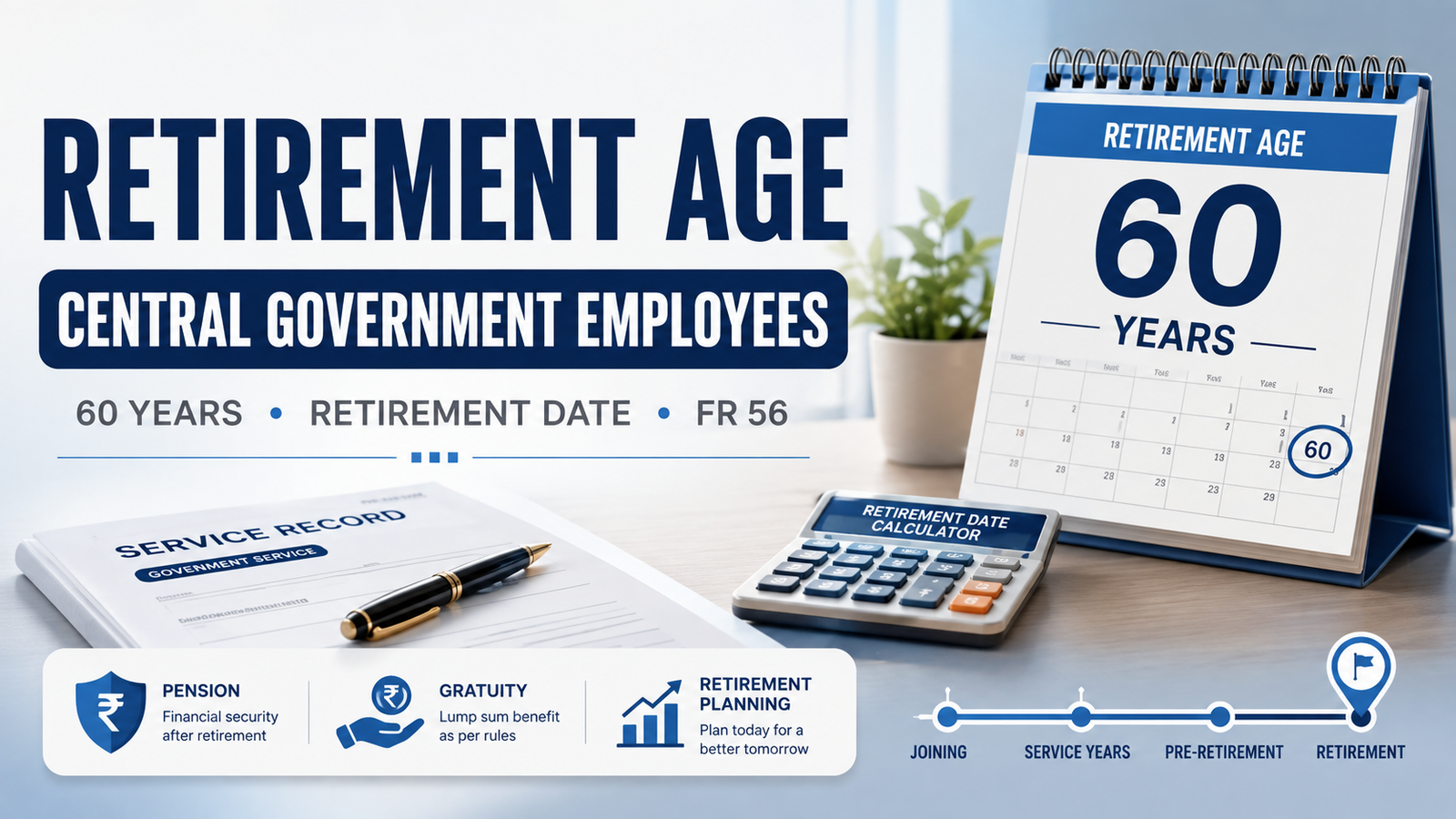
For most Central Government employees, the normal age of superannuation is 60 years. But knowing the retirement age alone is not enough to determine your actual retirement date.
The date of birth and the specific retirement rules applicable to the employee determine whether retirement falls on the last day of the same month or the preceding month.
Retirement Date Finder
Want to know your expected retirement date? Use our Retirement Date Finder to calculate it from your date of birth.
What Is the Retirement Age for Central Government Employees?
The normal retirement age for most Central Government employees is 60 years.
The relevant provision is contained in Fundamental Rule 56. It provides that, except where otherwise specified, a Government servant retires on the afternoon of the last day of the month in which he or she attains 60 years of age.
The Department of Personnel and Training (DoPT) publishes the Fundamental Rules and related instructions governing service matters, including retirement under FR 56.
How Is the Retirement Date Calculated?
This is where many employees get confused.
Your retirement date is not simply your 60th birthday. The rule generally links the retirement date to the month in which you attain 60 years.
| Date of Birth | Age of 60 Completed | Normal Retirement Date |
|---|---|---|
| 15 March 1966 | 15 March 2026 | 31 March 2026 |
| 20 July 1966 | 20 July 2026 | 31 July 2026 |
| 1 August 1966 | 1 August 2026 | 31 July 2026 |
Example 1: Date of Birth Is Not the First of the Month
Suppose an employee’s date of birth is 15 June 1966.
The employee completes 60 years on 15 June 2026.
Under the normal FR 56 rule, the employee would retire on the afternoon of 30 June 2026.
Example 2: Date of Birth Is the First Day of the Month
Suppose the date of birth is 1 June 1966.
The employee attains 60 years on 1 June 2026.
Since the date of birth is the first day of the month, the normal retirement date would be the afternoon of 31 May 2026.
Why Your Date of Birth Matters
A difference of just one day in the date of birth can change the retirement month.
For this reason, employees approaching retirement should check the date of birth recorded in their official service records rather than relying only on an informal calculation.
Are There Exceptions to the Age of 60?
Yes. The age of 60 is the general rule, but certain categories of employees are governed by separate provisions or may be eligible for extensions under specific circumstances.
For example, the FR 56 provisions contain special retirement-age provisions for certain specialists in the Central Health Service and certain nursing teaching faculty.
There are also provisions dealing with extensions of service for specific categories and posts in the public interest.
Retirement Age of Central Health Service Specialists
FR 56 contains special provisions for certain specialists in the Central Health Service. The applicable age can be higher than the normal 60-year retirement age depending on the category and nature of duties.
The rules also contain specific provisions for certain teaching and nursing-teaching positions.
Therefore, medical and teaching personnel should check the specific provision applicable to their post instead of applying the general 60-year rule without verification.
Can a Central Government Employee Retire Before 60?
Superannuation at 60 should not be confused with voluntary or premature retirement.
Separate service rules provide mechanisms under which an eligible employee may retire before reaching the normal age of superannuation, subject to the applicable conditions and notice requirements.
Therefore, an employee’s normal retirement date and the date of voluntary retirement are two different things.
What Happens After Retirement?
Retirement is not just about determining the final working day. Several financial and service benefits may need to be processed around retirement.
These can include pension-related benefits, gratuity, leave encashment and other retirement dues, depending on the employee’s service and applicable rules.
Our detailed guide on Retirement Benefits for Central Government Employees covers the major benefits that employees should be aware of before retirement.
Gratuity and Retirement
Gratuity is another important retirement benefit for eligible Central Government employees.
If you want to understand the calculation separately, see How Is Gratuity Calculated? You can also use our Gratuity Calculator for a quick estimate.
Leave Encashment at Retirement
Accumulated Earned Leave can also form an important part of retirement planning for eligible employees.
The amount payable depends on the applicable leave rules and the employee’s leave balance and pay components considered for encashment.
For a broader understanding of the applicable provisions, see our Central Government Leave Rules guide and use the Earned Leave Encashment Calculator for an estimate.
Commuted Pension After Retirement
Employees who are eligible for pension may also need to understand the option of pension commutation and how it affects their pension payments.
Our Commuted Pension Calculator can help you estimate the commuted portion of pension.
Retirement Date vs Last Working Day
The terms retirement date and last working day are sometimes used interchangeably, but employees should check the exact wording used in the applicable service order and departmental instructions.
Under the normal FR 56(a) provision, retirement takes effect in the afternoon of the prescribed retirement date.
This is one reason why the exact date should be calculated carefully when planning leave, pension papers, handover and other retirement formalities.
Retirement Planning Checklist
If you are approaching retirement, it is useful to start checking your records well in advance.
- Verify your date of birth in the official service record.
- Calculate your expected retirement date.
- Check your qualifying service and pension records.
- Review your Earned Leave balance.
- Check gratuity eligibility and estimated amount.
- Understand pension and commutation options.
- Complete the required retirement documentation within the prescribed time.
- Confirm the final retirement date with your establishment section.
Frequently Asked Questions
What is the retirement age of Central Government employees?
For most Central Government employees, the normal age of superannuation is 60 years, subject to the applicable service rules and specific exceptions.
Will I retire on my 60th birthday?
Not normally. Under FR 56(a), an employee generally retires on the afternoon of the last day of the month in which the employee attains 60 years of age.
What if my date of birth is the first day of the month?
If the date of birth is the first day of a month, the normal rule provides for retirement on the afternoon of the last day of the preceding month.
What if my date of birth is 15 August?
If the general FR 56 rule applies, the employee would normally retire on the afternoon of 31 August of the year in which the employee attains 60 years.
Is the retirement age 60 for every Central Government employee?
No. Sixty years is the general rule, but certain services, specialist categories and posts can have different provisions. The applicable service rules should always be checked.
Can a Central Government employee retire before 60?
In certain circumstances, an employee may be eligible for voluntary or premature retirement under the applicable service rules. This is different from normal superannuation at 60.
How can I calculate my retirement date?
Enter your date of birth in the CGStaffTools Retirement Date Finder to get an estimated retirement date under the general rule.
Official Rules & References
Retirement dates can affect pension, gratuity, leave encashment and other service benefits. For this reason, it is better to verify important cases against the applicable Government rules.
Important Note
This article explains the general retirement provisions applicable to Central Government employees. The normal retirement age is 60 years, but special provisions can apply to particular services, posts and categories of employees.
The retirement date shown by an online calculator should be treated as an estimate. Always verify the final retirement date with your official service record and the establishment or administrative section of your department.
Last reviewed: August 2026