Journey of Pay Commission in India: From 1st CPC to 8th CPC
The Pay Commission has played a major role in shaping the salaries, allowances, pensions and service conditions of Central Government employees. From the traditional pay structures of the early years to the modern 7th CPC Pay Matrix, the system has changed significantly over the decades.
Every few years, one question becomes especially important for Central Government employees: How will my salary change under the next Pay Commission?
To understand that question, it helps to look back at the complete history of Pay Commission in India.
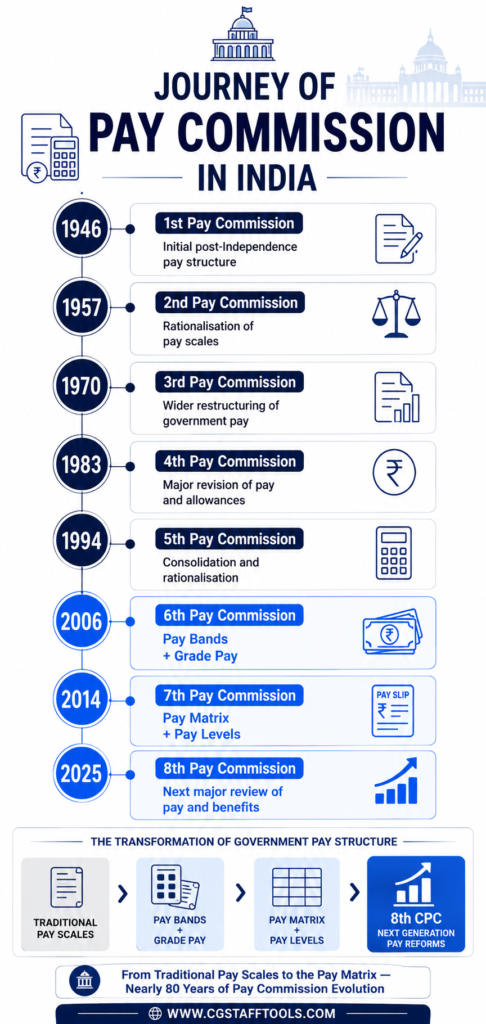
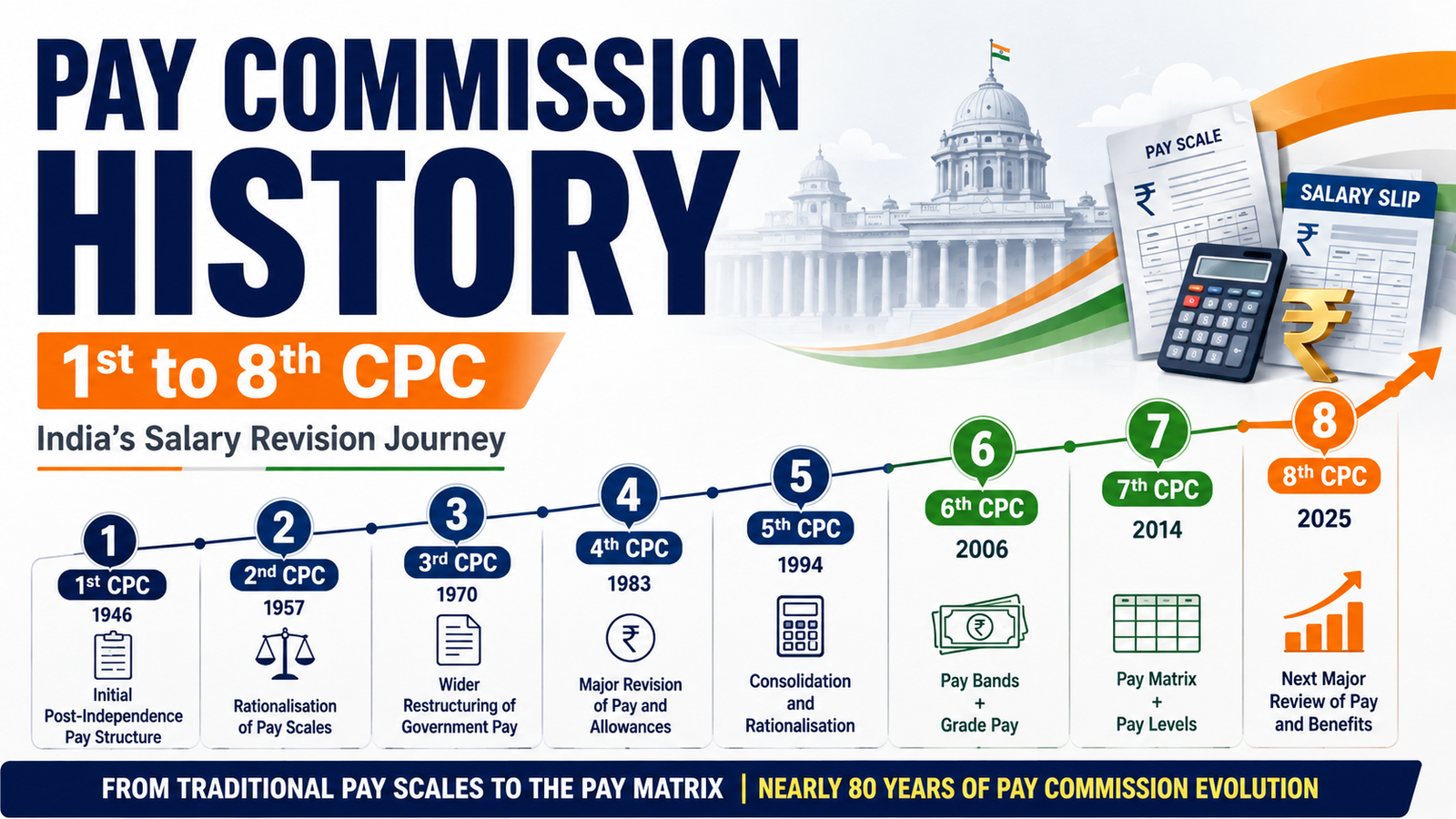
The journey began with the 1st Central Pay Commission in 1946. Since then, India has moved through traditional pay scales, Pay Bands and Grade Pay, and finally to the 7th CPC Pay Matrix.
The 8th Central Pay Commission now represents the next major chapter in this long journey.
- Pay Commission History at a Glance
- What is a Pay Commission?
- Why Does India Need Pay Commissions?
- Journey of Pay Commission in India
- 6th Central Pay Commission
- 7th Central Pay Commission
- 8th Central Pay Commission
- Pay Structure Evolution
- Complete Pay Commission Timeline
- Pay Commission vs DA
- What Could the 8th CPC Change?
- Useful Calculators & Guides
- Frequently Asked Questions
- Official References
📊 Pay Commission History at a Glance
| Pay Commission | Year / Period | Major Development |
|---|---|---|
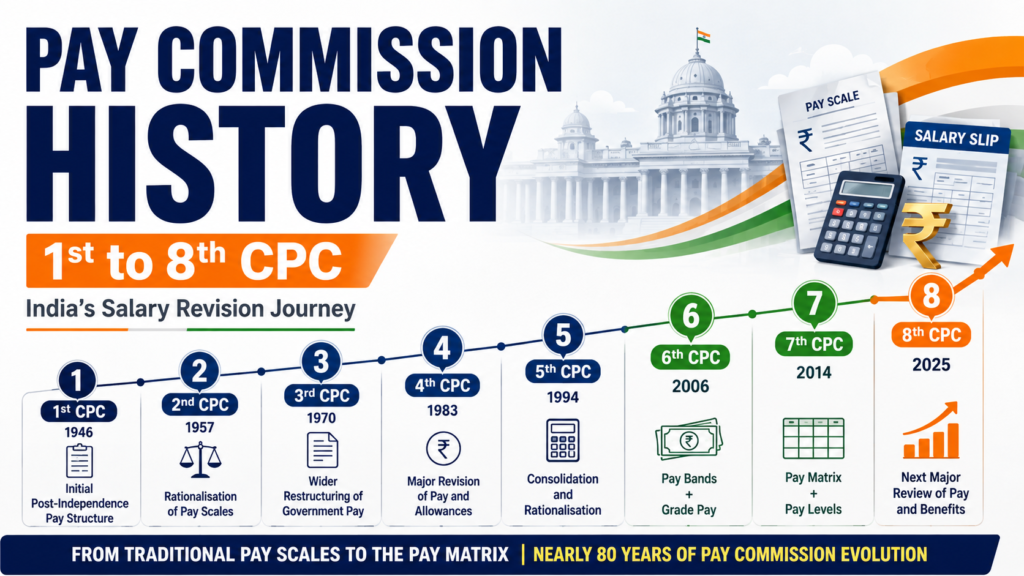
| 1st CPC | 1946 | Foundation of the modern Central Government pay structure |
| 2nd CPC | 1957 | Rationalisation of pay scales |
| 3rd CPC | 1970 | Wider review of pay and service conditions |
| 4th CPC | 1983 | Major restructuring of pay and allowances |
| 5th CPC | 1994 | Consolidation and rationalisation of pay scales |
| 6th CPC | 2006 | Pay Bands + Grade Pay |
| 7th CPC | 2014 | Pay Matrix + Pay Levels |
| 8th CPC | 2025 | Next comprehensive review of pay and benefits |
The official Department of Expenditure Central Pay Commission section provides official documents and orders relating to the Central Pay Commissions.
What is a Pay Commission?
A Pay Commission is a body constituted by the Government of India to examine the pay structure, allowances, pension and other service conditions of Central Government employees and pensioners.
It studies the existing system and makes recommendations for possible changes.
Areas that may be examined include:
- Basic Pay
- Pay Scales and Pay Levels
- Allowances
- Dearness Allowance-related issues
- House Rent Allowance
- Transport Allowance
- Pension
- Gratuity
- Retirement benefits
- Career progression
- Other service conditions
Why Does India Need Pay Commissions?
Government salaries cannot remain unchanged forever. The economic environment, inflation, cost of living and nature of government jobs continue to change.
A Pay Commission provides a structured mechanism for carrying out a comprehensive review instead of making salary changes on an ad-hoc basis.
🕰️ Journey of Pay Commission in India
The easiest way to understand the Pay Commission history is to follow the major developments chronologically.
1st Central Pay Commission
The First Central Pay Commission was constituted in 1946, before India’s Independence. It examined the pay and service conditions of government employees during a period of major administrative and political transition.
Its work helped establish the foundation for a more systematic approach to government employee compensation.
2nd Central Pay Commission
The Second Pay Commission was constituted in 1957. Its work focused on rationalising existing pay structures and examining relationships between different categories of government posts.
3rd Central Pay Commission
The Third Pay Commission was constituted in 1970. It examined government employees’ pay and service conditions in greater detail, including the relationship between pay, responsibilities and career progression.
4th Central Pay Commission
The Fourth Pay Commission was constituted in 1983. It reviewed pay scales, allowances, service conditions and retirement-related issues.
This represented another important stage in the restructuring of Central Government salaries.
5th Central Pay Commission
The Fifth Pay Commission was constituted in 1994. It examined the large number of pay scales that had developed over the years and focused on rationalisation and consolidation.
It also considered issues relating to allowances, pension, retirement benefits, recruitment and staffing.
6th Central Pay Commission
The Sixth Pay Commission marked one of the biggest structural changes in modern Central Government pay history.
It introduced the Pay Band + Grade Pay system, replacing the older traditional structure with a more organised framework.
The Sixth CPC also influenced important areas such as career progression, allowances and the overall salary structure.
The Department of Expenditure provides official documents relating to the implementation of the 6th CPC .
7th Central Pay Commission
The Seventh Central Pay Commission was constituted in 2014. Its recommendations led to the revised pay structure implemented with effect from 1 January 2016.
🚀 Goodbye Grade Pay. Hello Pay Matrix.
The 7th CPC replaced the Pay Band + Grade Pay system with the Pay Matrix.
Employees were placed into different Pay Levels, with multiple cells within each level.
Pay Level + Pay Cell = Basic Pay
The official 7th Central Pay Commission Report contains the Pay Matrix and recommendations relating to the revised pay structure.
Why Was the 7th CPC Pay Matrix a Big Change?
The Pay Matrix made salary progression easier to understand.
Before 7th CPC
Pay Band + Grade Pay + applicable rules
7th CPC
Pay Level + Pay Cell
This simplified the way employees could identify their position within the salary hierarchy and understand progression within a Pay Level.
8th Central Pay Commission – The Next Chapter
The 8th Central Pay Commission is the latest chapter in the history of Pay Commissions in India.
The Government announced the formation of the 8th CPC in January 2025. Its Terms of Reference were subsequently approved by the Union Cabinet in October 2025.
The Commission has been tasked with examining issues relating to the pay and service conditions of Central Government employees and other categories covered under its Terms of Reference.
In 2026, the Commission invited representations and memorandums from employees, pensioners, associations, unions and other stakeholders as part of its consultation process.
For the latest official information, always refer to the Press Information Bureau and the Department of Expenditure .
📢 8th CPC: Where Does the Process Stand?
The important point for employees is that the process involves several stages. A particular fitment factor, revised basic pay or new Pay Matrix should not be treated as final unless it is officially recommended and subsequently accepted by the Government.
📊 Pay Structure Evolution: A Simple Comparison
| Period | Main Salary Structure |
|---|---|
| Earlier CPCs | Traditional Pay Scales |
| 6th CPC | Pay Band + Grade Pay |
| 7th CPC | Pay Matrix + Pay Levels |
| 8th CPC | To be determined through recommendations and Government decisions |
In simple terms, the evolution can be remembered as:
🔍 What Has Changed Across the Pay Commissions?
1. Simplification
The salary system has gradually moved towards more structured and understandable methods of determining pay.
2. Rationalisation
Successive Commissions have attempted to establish clearer relationships between posts, responsibilities and pay.
3. Transparency
The 7th CPC Pay Matrix made it easier for employees to identify their Pay Level, Cell and progression.
4. Wider Review
Pay Commissions have increasingly examined not only basic pay but also allowances, pension and other service-related benefits.
Pay Commission vs Annual DA Revision
Pay Commission and Dearness Allowance are often confused, but they are not the same thing.
| Feature | DA Revision | Pay Commission |
|---|---|---|
| Frequency | Periodic | Long-term comprehensive review |
| Main purpose | Compensation for changes in cost of living | Comprehensive review of pay and service conditions |
| Basic Pay | Generally does not completely restructure basic pay | Can substantially revise the pay structure |
| Allowances | Specific DA-related changes | Wider review may be undertaken |
| Pension | Dearness Relief is periodically revised | Pension structure may be reviewed |
💡 Does Every Pay Commission Mean a Fixed Salary Increase?
No. There is no permanent rule stating that every Pay Commission must provide a particular percentage increase.
The final outcome depends on factors such as:
- Existing pay structure
- Inflation and cost of living
- Economic conditions
- Government finances
- Commission’s recommendations
- Government’s final decisions
🔮 What Could the 8th CPC Change?
Employees should distinguish between official information and unofficial projections when following 8th CPC developments.
Basic Pay
The existing basic pay structure may be reviewed as part of the Commission’s work.
Pay Matrix
The existing Pay Levels and Cells may be examined as part of the revised pay structure.
Fitment Method
The methodology for determining revised pay may be considered by the Commission.
Allowances & Pension
Various allowances, pension and retirement-related benefits may also be reviewed within the scope of the Commission.
🧮 Useful Calculators & Guides
Want to understand how different salary components work? Explore these useful tools and guides on CG Staff Tools.
📚 More Useful Guides
❓ Frequently Asked Questions
When was the First Pay Commission formed in India?
The First Central Pay Commission was constituted in 1946.
How many Central Pay Commissions have there been?
Eight Central Pay Commissions have been constituted, with the 8th CPC being the latest Commission.
Which Pay Commission introduced Grade Pay?
The 6th Central Pay Commission introduced the Pay Band + Grade Pay structure.
Which Pay Commission introduced the Pay Matrix?
The 7th Central Pay Commission introduced the Pay Matrix and Pay Levels.
When was the 7th CPC implemented?
The revised 7th CPC pay structure was implemented with effect from 1 January 2016, subject to the Government’s implementation decisions.
When was the 8th Pay Commission announced?
The Government announced the formation of the 8th Central Pay Commission in January 2025.
Has the 8th CPC started its work?
Yes. The Government has progressed with the constitution and functioning of the Commission, including the process of obtaining representations and inputs from stakeholders.
Will the 8th CPC automatically increase everyone’s salary?
No. The Commission will make recommendations. The Government will subsequently take decisions regarding acceptance and implementation.
Is the Pay Commission only about basic salary?
No. Pay Commissions can examine broader matters including allowances, pension, retirement benefits and other service conditions.
🎯 The Bigger Picture
The history of Pay Commission in India is much more than a list of salary revisions.
It reflects how the Central Government’s compensation system has evolved over almost eight decades.
The journey started with traditional pay structures. Over time, successive Commissions introduced greater rationalisation and structure.
The 6th CPC introduced Pay Band + Grade Pay. The 7th CPC introduced the Pay Matrix. And the 8th CPC has opened the next chapter.
For Central Government employees, understanding this history is useful because today’s salary structure is the result of decades of reforms.
The next major milestone will be the recommendations of the 8th Central Pay Commission and the Government’s decisions on those recommendations.
📚 Official References
For important salary, pension and Pay Commission matters, it is always better to verify information through official Government sources.
- Department of Expenditure – Central Pay Commission
- 7th Central Pay Commission Report – Department of Expenditure
- Department of Expenditure – Government of India
- Press Information Bureau – Government of India
- Department of Expenditure – 6th CPC Orders
- Department of Expenditure – 7th CPC Orders