
Retirement Benefits for Central Government Employees: A Simple Guide
Retirement is more than just the end of government service. For a Central Government employee, it can bring several important financial benefits — such as pension or retirement payout, gratuity, leave encashment and other eligible benefits.
But the exact benefits depend on the employee’s pension system, date of joining, qualifying service and the type of retirement.
What Are the Main Retirement Benefits?
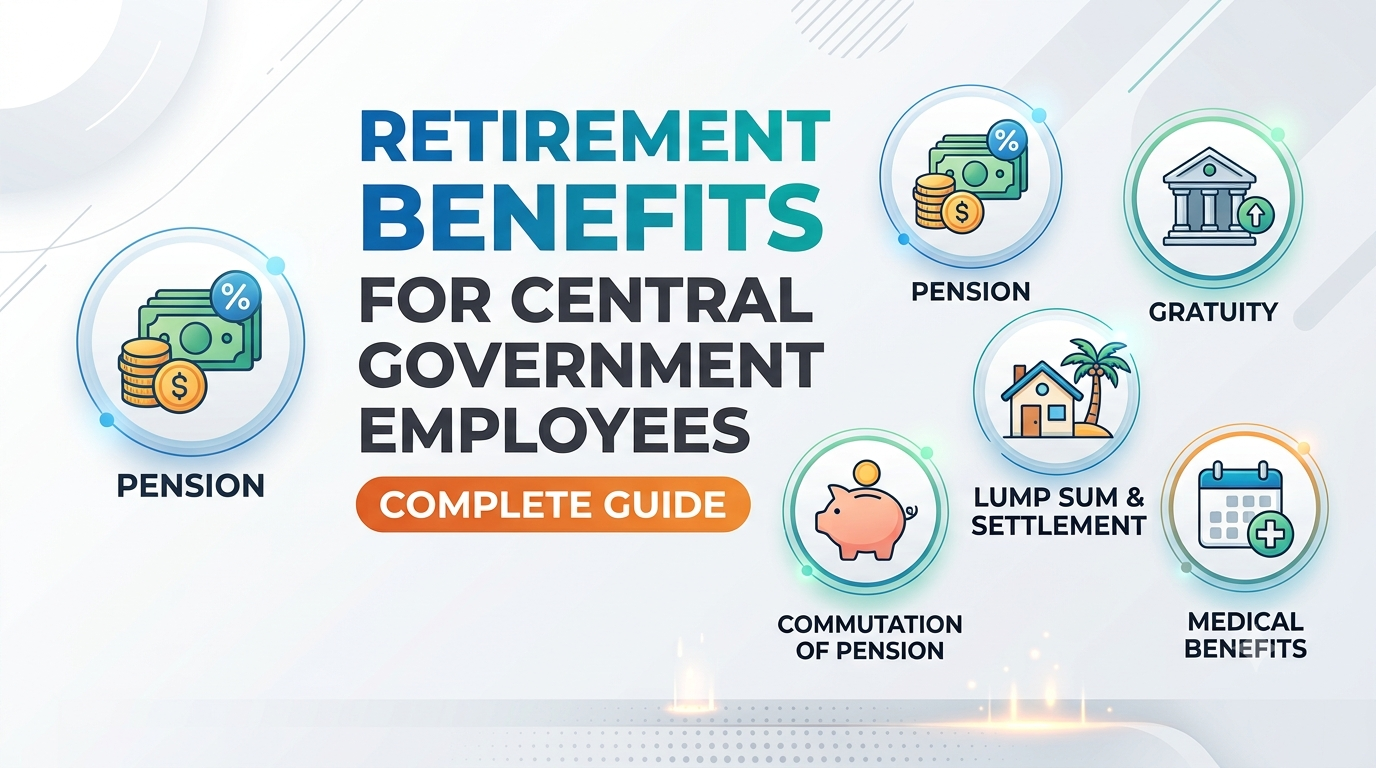
The benefits available at retirement can vary depending on the employee’s applicable pension rules. Broadly, Central Government employees may have the following major retirement benefits:
Other benefits may also apply depending on the employee’s service conditions, pension scheme and individual circumstances.
1. Pension or Retirement Payout
The first question most employees ask is: “How much pension will I get after retirement?”
There is no single pension formula applicable to every Central Government employee today. The applicable system depends on factors such as the employee’s date of joining and the pension option applicable to them.
Employees under the traditional pension framework are governed by the applicable Central Civil Services pension rules, while employees covered by NPS have retirement benefits linked to their accumulated retirement corpus and applicable exit rules.
Since 1 April 2025, the Unified Pension Scheme (UPS) has also been available as an option under NPS for eligible Central Government employees. UPS provides an assured payout subject to the prescribed conditions.
2. Retirement Gratuity
Gratuity is one of the most important lump-sum retirement benefits for eligible Central Government employees.
In simple terms, it is a payment made in recognition of qualifying government service, calculated according to the applicable rules.
Retirement gratuity should not be confused with monthly pension. Pension is generally a recurring retirement benefit, while gratuity is a lump-sum benefit.
Monthly pension / payout → money received periodically after retirement.
Retirement gratuity → eligible lump-sum amount payable on retirement.
The actual gratuity amount depends on the employee’s qualifying service, emoluments and the applicable rules and ceiling.
Employees covered under UPS are also eligible for retirement and death gratuity under the applicable Central Civil Service rules for NPS-covered employees.
3. Earned Leave Encashment
Another major retirement benefit is Earned Leave encashment.
If an employee has accumulated eligible Earned Leave at the time of retirement, the employee may receive cash equivalent to the admissible leave balance, subject to the applicable rules and maximum limits.
Suppose an employee has an eligible leave balance of 200 days at retirement.
If the applicable rules permit encashment of that balance, the employee may receive a lump-sum payment calculated using the prescribed formula and the admissible pay components.
The exact amount cannot be determined from the leave balance alone — the applicable pay components and statutory ceiling also matter.
You can use the CGStaffTools Earned Leave Encashment Calculator to estimate the amount based on the inputs applicable to your case.
4. What About Employees Covered Under NPS or UPS?
This is particularly important for employees who joined Central Government service under the National Pension System.
Under NPS, retirement benefits are connected with the accumulated pension corpus and the withdrawal/annuity rules applicable at the time of exit.
UPS is different in that it provides an assured payout subject to prescribed conditions and operates within the NPS architecture. It has been effective from 1 April 2025.
| System | Basic idea |
|---|---|
| Traditional pension framework | Pension is determined under the applicable Central Government pension rules. |
| NPS | Retirement benefit is linked to the accumulated pension corpus and applicable exit rules. |
| UPS | Provides an assured payout subject to the prescribed conditions and rules. |
A Simple Retirement Benefits Example
Suppose Arun is retiring after completing the required qualifying service. At retirement, he has:
| Benefit | What it means |
|---|---|
| Monthly pension / retirement payout | Regular retirement income under his applicable pension system |
| Retirement gratuity | Lump-sum benefit calculated under the applicable rules |
| Leave encashment | Payment for eligible accumulated Earned Leave |
| Other admissible benefits | Depends on service conditions and applicable rules |
So Arun’s retirement package is not just his pension. He may receive several different benefits, each governed by its own rules.
Why Your Last Pay Matters
Your final basic pay and other relevant pay details can be important when calculating several retirement benefits.
For example, pension calculations under the applicable pension framework may use the prescribed emoluments and qualifying service. Similarly, gratuity and leave encashment calculations depend on the components specified by the relevant rules.
This is why keeping your service book, pay records, leave balance and pension-related documents accurate is extremely important as retirement approaches.
What Should You Check Before Retirement?
It is also sensible to verify nominations for applicable benefits and ensure that personal and bank details are correctly recorded well before retirement.
Retirement Benefits: The Big Picture
| Benefit | Nature | Depends On |
|---|---|---|
| Pension / retirement payout | Recurring | Applicable pension system and rules |
| Gratuity | Lump sum | Qualifying service, emoluments and applicable rules |
| Leave encashment | Lump sum | Eligible leave balance and prescribed pay components/limits |
| Other benefits | Varies | Service conditions and applicable rules |
Retirement benefits = Monthly retirement income + Lump-sum benefits + Other admissible benefits
The exact combination depends on your pension system and service rules.
Frequently Asked Questions
Major benefits can include pension or retirement payout, retirement gratuity and Earned Leave encashment. Other benefits may apply depending on the employee’s service and applicable rules.
Eligible NPS-covered Central Government employees can receive retirement/death gratuity under the applicable rules.
Yes. PFRDA states that Central Government employees covered under UPS are eligible for retirement and death gratuity under the applicable Central Civil Service rules.
Eligible accumulated Earned Leave can generally be encashed at retirement subject to the applicable rules and prescribed limits.
No. Gratuity is a lump-sum retirement benefit, while pension or retirement payout is generally a recurring benefit.
No. Benefits depend on factors such as date of joining, pension system, qualifying service, retirement type and the rules applicable to the employee.
🔗 Official Government Resources
For the latest rules, orders and official information on Central Government retirement and pension benefits, you can refer to these Government websites.